Blu Lacy to Howard 765kV Transmission Line

Routes Are Still Preliminary. Your Window to Act Is Now.

AEP Texas and CPS Energy have notified the preliminary routes for the Blu Lacy to Howard 765-kV line, but nothing is final yet. Here's what you need to know and what you can do today.

Blu Lacy to Howard at a Glance

AEP Texas and CPS Energy state that this is a joint effort to build roughly 150 miles of new 765 kV transmission line between Nueces and Bexar counties, plus two new substations. The Blu Lacy to Howard line is one segment of the larger TX 765 kV STEP Eastern Backbone. The Eastern Backbone is one part of ERCOT's broader Strategic Transmission Expansion Plan (STEP), which also includes the Permian Basin Reliability Plan, totaling roughly $33 billion before financing and maintenance costs. This marks the first time 765 kV transmission lines have ever been built in Texas.

Current Status

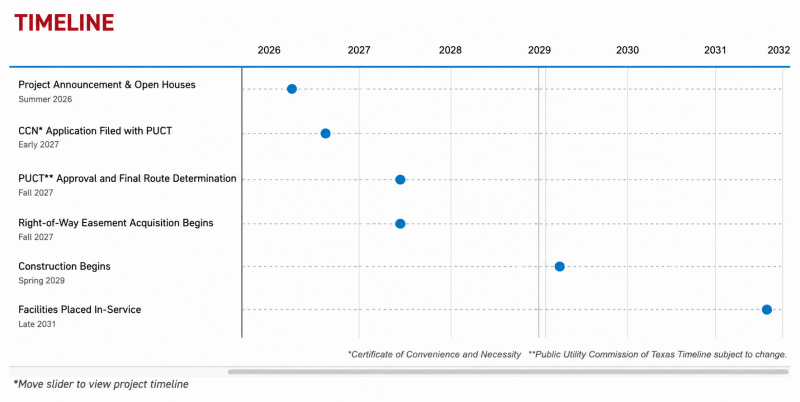
AEP Texas and CPS Energy are in the preliminary planning and route input phase for this project. They will hold open houses to collect landowner feedback, but no route has been finalized and no formal application has been filed with the Public Utility Commission of Texas. This is the window landowners have to organize and weigh in before the project moves into a formal docket. The timeline presented (below) indicated that the transmission service providers plan to file a formal CCN application early 2027.
Deadlines & Meetings

September 25, 2026 (est) - Landowner feedback is being accepted through around September 25, 2026, and can be submitted to AEPTexasOutreach@aep.com (Kimberly Perez, Load Outreach Specialist) or BluLacy-Howard@cpsenergy.com (Antonio DeMendonca, S&T Regulatory Support Project Manager); if you have questions about what information to share, consider consulting an attorney before you submit.

AEP Texas and CPS Energy have planned open houses across the project area:

  • August 25, 2026: Alice, TX
  • August 26, 2026: George West, TX
  • August 27, 2026: Floresville, TX

You can find the meeting details here (link).

Counties Affected

AEP Texas and CPS Energy have not published their notified counties, but from the map, the counties affected as part of this preliminary phase appear to be:

  • Atascosa
  • Bexar
  • Duval
  • Frio
  • Jim Wells
  • Karnes
  • Kleberg
  • Live Oak
  • McMullen
  • Nueces
  • San Patricio
  • Wilson

Taking Action During the Preliminary Phase

During the preliminary phase, landowners have several options for learning more, asking questions, documenting concerns, and making their voices heard. You do not have to wait for a notice letter to begin preparing. Texas transmission cases can move quickly once an application is filed. There are practical steps you can take now. The information below is intended to help you understand some of the actions you may choose to take and provide the resources you need to take them.

This is not legal advice, and there is no single “right” way to participate. Every property and situation is different. These are simply options available to landowners who want to become informed and engaged before a formal application is filed.

Find your property on the project map

What this option means: Locating your parcel on the utility's published interactive map can tell you whether your property is on a preliminary proposed route, or just within the broader study area. Reviewing the interactive map with satellite overlay also lets you check your own property and surrounding area for accuracy, as outdated satellite imagery can be missing structures (houses, schools, churches, etc), land use changes, or other constraints that should factor into route consideration.


Potential benefit during preliminary phase: The earlier you know your position relative to the line, the more time you have to plan. And if the imagery on file is outdated, catching that now, while the route is still preliminary, gives you a chance to flag it (either for yourself, with the utility, or with an attorney), rather than discovering it after a route is already further along.

Learn the timeline

View the timeline for the process for new transmission facilities in Texas here. 

What this option means: It is key to understand the general sequence a transmission project follows: preliminary notice, comment period, CCN application, intervention window, SOAH hearing, PUC decision, and roughly where this project sits in that sequence right now.

This Blu Lacy to Howard line is in the "Public Information Meeting" aspect of the Routing and Environmental Study phase as of August 2026. 

Once a CCN application is formally filed, Texas law requires the PUC to issue a final decision within 180 days of the filing date. Within that same window:

  • Landowners have 30 days from the date the application is filed to file a motion to intervene (this was reduced from a prior 45-day window).
  • The hearing on the merits is typically scheduled about two and a half months after the application is filed, and discovery and direct testimony deadlines for intervenors fall just days to a couple of weeks after the 30-day intervention deadline; so a landowner who waits until day 30 to intervene may have only about a month and a half before the hearing.
  • SOAH takes approximately 60 days to review the case and present the PUC with a Proposal for Decision. Then, the PUC takes roughly 35 days before the 180-day deadline to review the SOAH recommendation and reach its final decision on the route. 

Potential benefit during preliminary phase: Preliminary notice usually comes months before a CCN application is filed. That gap is unstructured time most landowners don't realize they have. Once the CCN application is filed, the clock moves fast: 30 days to intervene, discovery and testimony deadlines close behind that, so understanding the compressed timeline now, before it starts, is what allows a landowner to actually act within it rather than lose the window without realizing it had opened.

*For help understanding the terms on this site, please see our tutorial here (link).

Connect with nearby landowners

What this option means: Identifying and reaching out to other property owners along the route or in the study area to share information and compare notes. Since there is no published list of who has been notified, many landowners use their county's CAD (Central Appraisal District) parcel maps alongside the utility's interactive route map to identify neighboring property owners along the corridor and reach out directly. It's also worth talking to anyone nearby regardless of whether they appear to be directly on a route, as preliminary routes can shift, existing routes can change, and entirely new alternative routes can be added later in the process, so today's map isn't necessarily tomorrow's.

Potential benefit during preliminary phase: Neighbors often catch different details, hear different things at open houses, and have different capacity to attend meetings; pooling that informally tends to benefit everyone, and relationships built early make later coordination much easier. Casting a wider net now, rather than only contacting landowners on the current route, also means you're not left scrambling to build those connections later if the route shifts and new landowners suddenly find themselves affected.

Document your land

What this option means: Creating a dated photo/video record of your property as it exists today, including structures, tree lines, fencing, water features, wildlife, viewsheds.


Potential benefit during preliminary phase: Having a clear "before" record, made independently and before any activity on your land, is simply good practice for any landowner facing a nearby project, as it preserves your own account of your property's condition, no mater what happens next.

*Please research and/or consult an attorney before soliciting an appraisal of your property.

Gather your property records

What this option means: Collecting your deed, plat/survey, title policy, existing easements, mineral leases, tax appraisal, and any well/septic or ag/wildlife exemption paperwork in one place.


Potential benefit during preliminary phase: Having these organized ahead of time saves you possibly needing to scramble later, and it's the kind of thing that's genuinely easier to do calmly now than under a deadline. If you ever do need legal counsel, having this ready in advance saves time and often cost.

Research the project

What this option means: This entails learning about CPS Energy and AEP Texas, the STEP Expansion plan by ERCOT, and what other segments or projects this line connects to. Beyond the basic project overview, landowners benefit from digging into:

  • Who — Which transmission service provider(s) are involved, who owns and operates the line once built, and who the decision-makers are at each stage (transmission service provider staff, PUC commissioners, administrative law judges at SOAH).
  • What — The physical scope of the project. For comparison, AEP's own materials for the Blu Lacy to Howard segment cite a typical structure height of 160–180 feet, a typical right-of-way width of 200 feet, and structures spaced roughly every 1,200 feet; although design specs can vary project to project.
  • When — The project timeline: preliminary route notification, open houses, the filing of the application (CCN) with PUCT, the SOAH hearing schedule, and the estimated in-service date. Knowing where a project sits in this timeline shapes what kind of input is still possible.
  • Where — Not just the proposed route through their own property, but the alternative routes under consideration, since a route can still shift during the docket process.
  • Why — The stated need for the project (grid reliability, load growth, storm resiliency, connection to other segments), so landowners can evaluate whether the justification matches what's being proposed.
  • How — How the right-of-way is cleared and maintained (access road construction, tree/vegetation removal, structure installation, then restoration of the property afterward), how easement compensation and appraisals typically work, and the estimated cost of the project, which can inform questions about valuation and long-term land impact.

Potential benefit during preliminary phase: Understanding the "why" behind a project helps landowners ask better questions at open houses and evaluate public materials with more context, rather than reacting to the map alone. Understanding the "what" and "how," including structure size, easement width, clearing process, and cost, helps landowners grasp the practical, day-to-day impact on their land, not just its presence on a map. Landowners who go in with this fuller picture tend to ask sharper, more specific questions at open houses, and are less likely to be caught off guard later by aspects of the project they didn't know to ask about up front.

*For help understanding the terms on this site, please see our tutorial here (link).

Understand the PUC factors for consideration

What this option means: It can be very helpful to familiarize yourself with the public factors the Public Utility Commission considers when evaluating a proposed route (e.g., community values, recreational/park areas, historical/cultural resources, environmental integrity, engineering constraints, and cost). 

You can view the PUC factors for consideration in the approval/siting of new transmission facilities here (link).

Potential benefit during preliminary phase: Knowing the factors the Commission actually weighs helps landowners understand what kind of public comments and evidence tend to be relevant later in the process (this is not a guarantee of legal effectiveness).

*For help understanding the terms on this site, please see our tutorial here (link).

Have a plan for if/when you receive CCN Application notice

What this option means: Thinking ahead about what you'd want to do the day an official CCN application notice arrives means having a plan: who you'd call, what deadlines start ticking, and what questions you'd want answered. It also means understanding, ahead of time, the different levels of intervention and protest available to landowners, since each level carries a different amount of effort, time, and financial cost, and it's easier to think through that trade-off calmly now than to sort it out under a countdown clock. To help with that, we've put together a decision tree that walks through the different paths and what each one typically involves.

You can view the decision tree here. 

Potential benefit during preliminary phase: A CCN notice starts formal clocks (like intervention deadlines). Having even a rough plan beforehand, including which level of involvement fits your situation, time, and budget, means you're not figuring out your options for the first time under time pressure. Working through the decision tree early also helps you see the full range of options up front, rather than defaulting to the first one you hear about or the loudest opinion in the room.

*For help understanding the terms on this site, please see our tutorial here (link).

Consult an attorney early

What this option means: This is your opportunity to reach out to an attorney who handles PUC cases before you're facing a deadline, even if just for an initial conversation, not necessarily formal representation. Any licensed attorney can assist with the intervention process, though a PUC-experienced attorney is typically the most sought after given how technical and procedural these cases are. Legal costs vary widely depending on the scope of the case a landowner or group wants to put on, from a limited role for parts of the process, up to costs that can run as high as $500,000 for a fully litigated case, and often include expert witness fees, which tend to be most effective when the expert is identified and given substantial advance notice rather than brought in late. Because of the cost involved, many landowners group-fund an attorney together with others along their segment.

Potential benefit during preliminary phase: This is genuinely a legal and financial decision, not something to take advice on from a coalition, but knowing that this option, its typical cost range, and its timing exist is information every landowner in the notification area should have. The process moves quickly and is procedurally complex once it starts, so landowners who explore attorney options (including group-funding with neighbors and lining up experts early) before a deadline hits tend to have more choices than those who start looking after the clock has already started.

Engage your legislators and the media

What this option means: This means contacting your county judge, county commissioners, state representative, state senator, and any other representative all the way up to Governor Abbott to let them know a transmission project is affecting your area and community, and how you feel about it. If you're in an incorporated area, this also includes your city council/city representatives.

It also means reaching out to local and regional media, including newspapers, TV stations, radio, and community news outlets, to make sure the story of what's happening in your community is being told. This can include submitting an op-ed or letter to the editor, calling a reporter who covers local government or energy issues, or simply making yourself available as a contact when a story on the project comes up.

Potential benefit during preliminary phase: Legislators and local officials respond to constituent volume and stories. Early, organized outreach, before a project becomes contentious in the news, tends to carry more weight than a single letter after the fact. Legislators are also occasionally able to get information from the TSPs (transmission service providers) more quickly than individual landowners can on their own, so keeping them informed early can end up benefiting the broader group, not just the person who reached out.

Media coverage works on a similar logic. A project that's been reported on is harder for a TSP or regulator to treat as a non-issue, and press attention often prompts legislators and officials to engage who might not otherwise prioritize it. Getting ahead of the story, rather than reacting to it once routes are contested, also gives your community more control over how the issue is framed from the start.

Additionally, some areas have formed 391 Commissions (regional planning commissions under Local Government Code Chapter 391) specifically to advocate for constituents on projects like this, but that's typically something the public has to initiate and request, not something that happens automatically.

Know your rights

What this option means: Texas law provides landowners certain protections and processes in eminent domain and utility easement matters (e.g., required notice, negotiation processes, compensation standards). 

Potential benefit during preliminary phase: Landowners who understand the general framework tend to feel less blindsided and ask sharper questions, but any application to your specific property should go through an attorney, not general materials.

*For help understanding the terms on this site, please see our tutorial here (link).

Know who to call

What this option means: It is key to know how to actually participate, such as how to phone or dial in to PUC open meetings for public comment, how to submit written comment to a docket, and who to call at the utility, the county, or a landowner group with questions.

Potential benefit during preliminary phase: A lot of landowners want to participate but don't know the mechanics. Having the actual phone numbers, docket comment instructions, and meeting call-in info ready removes the biggest barrier to showing up.

Hillje to Blu Lacy Project Contacts

Office of Public Utility Counsel (OPUC)
OPUC represents residential and small business consumers, as a class, not individually, in cases before the PUC, SOAH, and state/federal courts. They're a resource for understanding the process, though they don't provide individual case representation for a specific landowner.

PUC Office of Public Engagement (OPE)
OPE educates Texans on PUC activities and how to participate in rulemakings, rate cases, hearings, and open meetings, so this is the office to call for questions about how to get on the record or attend/comment at an open meeting.